Tuesday, April 5, 2016

‘Taking Space’ at the Crypt Gallery, St Ives

Last week I had the privilege of showing my monoprints alongside three well-established artists who are members of ‘Taking Space’. Those of you who have followed my writings will remember my article about Mary Fletcher, who founded the group in the early 1990s. ‘Taking Space’ continues to flourish, with six exhibitions last year, not only in St Ives, but also Penzance, Falmouth and Porthleven. Participants work democratically, sharing responsibility for organising and holding exhibitions, and maintaining the group’s profile between shows. The changing membership of this diverse collective of women artists working in Cornwall contributes to its energy and vitality.
Setting up: Karen and Beverley’s paintings
The latest show at the Crypt (and the first of 2016) included an array of watercolours by Karen Smith, who studied textiles and graphic design in Southend before moving to Truro. A member of ‘Taking Space’ since 2005, Karen has exhibited her work throughout Cornwall. Her sensitive representations of anemones and sweetpeas were described by visitors as ‘superb’ and ‘exuberant’.
Anemones III
Acrylic ink on canvas
Karen Smith
Interspersed among her watercolours were some very large abstract acrylic canvases, a new departure for this versatile artist who also excels at life drawing.
Jo III
Watercolour
Karen Smith
In complete contrast were Beverley Morgante Le Levier’s bold, vibrant acrylic abstracts, reflecting this painter’s exuberant personality. Beverley is half Italian, and her paternal family roots have been traced back to eighteenth-century Florence. With a French husband, and family in Italy and Spain, Beverley’s command of three European languages comes in handy. Her artistic potential was recognised early on, but it was many years before circumstances allowed her to focus on forging an artistic career for herself.
Green Zephyr
Acrylic on canvas
Beverley Morgante Le Levier
Pink Zodiac
Acrylic on canvas
Beverley Morgante Le Levier
Entirely self-taught, Beverley is inspired by the interplay between colours and nature’s endless diversity of pattern, texture and form, particularly in micro-organisms. The use of a wide range of collaged elements in her work testifies to a rich imagination and adventurous spirit.
Having followed Mary Fletcher’s career over the years, I was intrigued to notice a change of direction in her latest work. ‘Looking towards Newfoundland’ is a large painting which eloquently expresses the frailty of the solitary figure, dwarfed by a vast expanse of sand, sea and sky. Reminiscent of Caspar David Friedrich’s iconic ‘Monk by the Sea’, the power of this image stems from the fact that it speaks to the viewer on a variety of levels.
Looking towards Newfoundland ~ Mixed media/collage by Mary Fletcher
Mary’s creative energy seems boundless. St Ives Arts Club is hosting a solo show of her drawings, ‘Picturing Pedyr and other People’ until 8 April. And a small stoneware piece by her entitled ‘New Year Bear and Fairy’ can be seen at the Penwith Gallery until 16 April.
My introduction to the world of art making began in 2012 when I participated in, and then wrote about a printmaking course at Newlyn School of Art. I became fascinated by the element of surprise inherent in the monoprinting process.
Back home I started making cards and small framed images – each one unique, as a monoprint cannot be replicated.
A chance meeting with Mary Fletcher last autumn led to my application for membership of ‘Taking Space’. In February I was fortunate enough to be accepted into the group, becoming the 100th member since its inception! The prospect of exhibiting my work in such an awe-inspiring venue was thrilling yet terrifying. The Crypt’s association in 1946 with figures such as Peter Lanyon and Sven Berlin, joined later by Barbara Hepworth and Wilhelmina Barns-Graham, represented a seminal moment in the narrative of St Ives modernism. It seemed that my monoprints had no place in such a hallowed setting. But once our artwork was in position (with the added bonus of pristine white walls and superb lighting) the Crypt seemed an entirely appropriate location for our show.
Helen's monoprints
The inspiration for ‘Luna with lunaria’ came from a friend who has a childhood recollection of her mother calling the seed cases of the honesty plant ‘moon pennies’. In this piece I experimented for the first time with mulberry paper, a delicate yet versatile material which I love for its fibrous, semi-transparent quality.
Luna with lunaria
Mixed media
Helen Hoyle
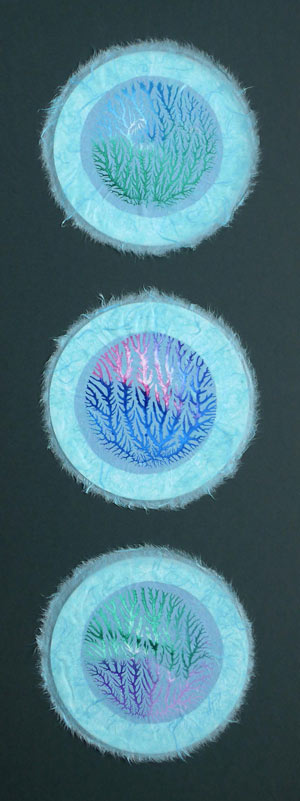
Mulberry paper also found its way into the dendritic monoprinting technique used in Fractal Forest (right, acrylic on mulberry paper).
Among the hundreds of visitors who saw our work last week were several former members. It was fascinating to hear of their experiences and to discover where their art practice has taken them over the years. By the end of the week-long show I felt exhilarated by the realisation that ‘Taking Space’ had given me an opportunity which might never otherwise have come my way. The prospect of participating in further shows this year is exciting. Whatever happens, the momentum and creative energy of ‘Taking Space’ has given me the confidence to question my self-imposed limitations, and the freedom to allow my artistic journey to unfold in a direction as yet unknown.
Karen Smith’s work is on permanent display at the Camelford Gallery. She is exhibiting during June and July in the Gallery Room at Bradworthy Inn, in Devon. From 5-14 July her paintings can be seen at the Cornwall Watercolour Society’s show at the Rock Institute.
Beverley Morgante Le Levier will be participating in a group show at the Old Lifeboat House in Porthleven from 23 to 29 July. Immediately afterwards, her work will be shown at the Crypt, in an exhibition running from from 30 July to 5 August.
‘Taking Space’ can be found at www.takingspace.co.uk and is also on Facebook.

© Helen Hoyle 2016

Saturday, July 11, 2015

The Florence Munnings Story


In the wake of the success of the recent movie ‘Summer in February’ I set out to establish the level of interest shown in Florence Munnings and the Lamorna artists. She was the key figure in the tragic sequence of events which unfolded in west Cornwall on the eve of the First World War.

Astonished to discover that the online photograph of her headstone had attracted over fifty thousand views, I persuaded my friend the artist Gabrielle Hawkes to accompany me on a journey into the past. Together we explored the locations, characters and artworks central to the narrative. It is not surprising that so many people continue to be moved by Florence’s story.

The result is the first YouTube video from Cornish Muse: ‘The Florence Munnings Story’.

Thursday, February 26, 2015

A Beginner’s Guide to Acrylics ~ with Yvette Wiltshire

St Ives and Penzance are well known as centres for art classes and workshops, but top class art tuition is also available in other parts of Cornwall. On a Saturday earlier this month I headed towards Liskeard to attend Yvette Wiltshire’s  (right) ‘Beginners Guide to Acrylics’ – one of a range of workshops and courses which she offers at various locations in mid Cornwall. Yvette’s interest in art began in the early 1990s, when her Father decided to take up painting as a retirement hobby.

Sunday, August 31, 2014

Sandra Blow 1925-2006 ~ in Search of Balance

Sandra Blow was described by Roger Hilton as an ‘heroic painter’. Certainly her late artworks are heroic in size. Currently her canvases can be seen at three locations in Cornwall. The Exchange in Penzance is showing a dozen works from the 1990s onwards, including Brilliant Corner II. Familiarity with reproductions of Blow’s work is nothing like the awe-inspiring experience of getting up close to these enormous originals.

Tuesday, May 6, 2014

Amongst Heroes ~ Royal Cornwall Museum

We live in an age of equal rights. Female stars of stage or screen, once known as actresses, are nowadays more usually described as actors. While the word ‘seamster’ exists in The Shorter Oxford English Dictionary, I have yet to come across a male version of a seamstress (though ‘tailor’ is still in use). But ‘hero’ has for some time transcended gender barriers, and I was heartened to see that a number of women, both artists and subjects, are included in ‘Amongst Heroes’. My particular interest in the representation of women in art attracted me to three images from an exhibition which highlights the lives of the ordinary working people of Cornwall over a century ago.

Wednesday, February 12, 2014

Morag Ballard at Lemon Street Gallery, Truro

Approaching Lemon Street Gallery one morning in January, I had a feeling that Morag Ballard’s first solo show in Truro would surprise and delight me. I was not disappointed. The pristine white walls of Gallery One provide the perfect backdrop to her striking artworks. Spare, clean lines on curved boards or undulating surfaces induce a feeling of calm, while reliefs and collages set out to tease - and challenge - the eye, oscillating between the two- and three-dimensional. Geometric form takes precedence over colour, yet the shimmering hues, meticulously applied, imbue the canvases with a lively rhythm.

Wednesday, December 11, 2013

Barbara Tribe Revisited

Thirteen years after she died, and on the centenary of her birth in 1913, a collection of drawings by Barbara Tribe has found its way back to Cornwall. The portfolio was acquired by a private collector from an Oxford gallery in 2009.
Although best known as a sculptor, Tribe’s ability in other media was formidable. As I have written elsewhere after her husband’s death in 1961, she added ceramics to her repertoire of talents, creating some memorable pieces in that medium. But her drawings, like those of Barbara Hepworth, have always held a particular fascination for me, and I am delighted to be able to reproduce a selection of them here.

Thursday, October 31, 2013

Margaret Mellis and St Ives Modernism


Margaret Mellis spent only seven years in Cornwall, yet this period would prove the most formative in a long and wide-ranging career. Fear of impending war brought her to Carbis Bay, near St Ives, in 1939 and the breakup of her marriage in 1946 drove her away.
Of course Mellis was not alone in finding sanctuary in the south west, but she and her husband, the painter and critic Adrian Stokes, were the first of their Hampstead circle to move to Cornwall.

Friday, June 7, 2013

Open Studios Cornwall 2013
Margaret Deans and Julia Cooper

Colour has always been a catalyst for Margaret Deans, and is also linked to turning points in her life. Formerly a garden designer, her experience of bereavement signalled a turning away from the pastel shades she had loved. Bright, vibrant colours began to dominate her planting schemes. Some years later, during a prolonged and uncertain period of recovery from illness, she took up painting. From then on, colour became a life-affirming element of the creative process.

Thursday, March 21, 2013

Summer in February
Art in Lamorna ~ 1910-1914
Penlee House Gallery

Summer in February, Jonathan Smith’s novel relating the turbulent events in Lamorna on the eve of the First World War, is an absorbing read. A film of the same title is due to be released in the UK later this year. Penlee House’s latest offering is a beautifully crafted show which links the two, locating both book and film within the context of a unique artistic community whose members are pictured at work and play.

The exhibition was opened last week by Jonathan Smith, who has written the screenplay for the film adaptation. A window display at the Gallery’s entrance includes stills from the forthcoming film, together with the wedding dress worn by the actor Emily Browning.

A delicately rendered landscape in watercolour entitled ‘The Moor’ testifies to the fact that Florence Carter Wood came to Cornwall to study art. This image, a rare canvas by the aspiring painter, is the first of many visual delights which offer an intimate look into the lives of the Lamorna artists and their friends during the closing years of the Edwardian era. ‘Lamorna Cove’ below, by one of the earliest residents of the valley, Samuel ‘Lamorna’ Birch, is undated yet conveys the atmosphere of an era of innocence which was soon to disappear forever.
Samuel John Lamorna Birch (1869 – 1955)
Lamorna Cove
date unknown
Oil on canvas,
28 x 19 cm
Private Collection, image courtesy Messums
© The Artist’s Estate

The community had grown since the founding in 1899 of the Forbes School of Painting in nearby Newlyn. The active involvement of Stanhope Forbes’ wife Elizabeth made the school particularly appealing to women seeking art tuition, and Florence was one of several female students attracted by its reputation. A further incentive for Florence was the fact that her brother Joey was already studying under Stanhope Forbes. Among her fellow students she found companionship and acquired the unflattering nickname ‘Blote’.

Much of the detail of Florence’s life remains undocumented. She is best known as the subject of a number of portraits by the artists of Lamorna. A pair of oils by Harold Knight (one dated 1911) show her in profile, a fine-looking young woman in her early twenties, whose bearing is somewhat aloof. Those who knew Florence found her introverted and prone to depression. Harold was a man of few words who enjoyed working quietly in his studio, so it is likely that the two were comfortable in each other’s company. Laura Knight, while deeply committed to her art, was in many respects the opposite of her husband. She was an extrovert and loved being part of a social circle whose pursuit of pleasure included a great deal of late-night revelry, in which the flamboyant Alfred (AJ) Munnings played a conspicuous role.
Harold Knight (1874 – 1961)
Portrait of Florence
1911 Oil on canvas
74 x 61.5cm
Private Collection
© Reproduced with the permission of
the Estate of Dame Laura Knight
DBE RA 2013 All Rights Reserved.

Florence’s quiet beauty proved irresistible to Alfred, with whom she shared a love of riding. She proved ideal as a model for his equestrian paintings, most famously in ‘The Morning Ride’ on loan for this exhibition, which forms the cover image of Jonathan Smith’s novel.
Alfred Munnings (1878 – 1959)
The Morning Ride
c.1912 Oil on canvas
51.5 x 61.5 cm
Private Collection,
c/o Christie’s Images Limited (2000) © Estate of Sir Alfred Munnings. All rights reserved, DACS 2013

The narrative of Summer in February unfolds from the point of view of Captain Gilbert Evans, who kept diaries of his time in Lamorna. The highly respected and well-liked local land agent, he was torn between loyalty towards his friend Alfred Munnings and his growing love for Florence, in whom he found a kindred spirit. But his lack of confidence prevented him from declaring his feelings for her, and he was devastated when the pair announced their engagement. It was evident not only to Gilbert that Alfred and Florence had little in common. They were considered an ill-matched couple by Lamorna Birch, and by the Knights. Beneath his brash charm Munnings could be insensitive and cruel. Spending a great deal of time away in London or visiting his family roots in Suffolk, he led the life of a carefree bachelor, leaving Florence behind in Lamorna, where Gilbert could be relied upon to keep her spirits up. Gilbert and Florence were in the habit of taking walks together in the beautiful Lamorna valley or along the clifftops, and it was one of these occasions, described in his diary as taking place on a ‘summer’s day’ but dated in February, which inspired the title for the book.

The companion piece to ‘The Morning Ride’ is ‘Portrait of Florence Munnings at Sunset’ by her husband, painted soon after their marriage. Clad in a pale flowing dress, the subject sits atop a stone wall, scarcely distinguishable from her surroundings, flecked with the last rays of the dying sun. The loosely applied brushwork lends her form a remote, ethereal quality.
Alfred Munnings (1878 – 1959)
Portrait of
Florence Munnings at Sunset

1912 Oil on canvas
53 x 61 cm
Private Collection
© Estate of Sir Alfred Munnings.
All rights reserved, DACS 2013

Florence was already deeply unhappy in her marriage. During Alfred’s frequent absences she and Gilbert found solace in each other’s company. Gilbert’s background comes to life in the exhibition through photographs of him posed with fellow players in the 1st XV rugby team at school (c.1899) and later as a member of the Monmouth Militia. Displayed in a cabinet are his medals, including those awarded for service during the Boer War. Also on show are his regimental sword and his fishing rod.

Although his love affair with Florence remained a secret to all but a few, Gilbert was finding the situation intolerable. Early in 1914 he resolved to resign from his job in Lamorna, to join the colonial service in Nigeria. On the eve of his departure, he and Florence met in London. A poignant memento of this occasion was retained by Gilbert. It is the receipt for their lunch, headed ‘14.4.1914, Trocadero Restaurant, Piccadilly Circus’. Afterwards, Florence accompanied him to Paddington Station, where they parted. His diary continues the narrative: ‘I went to the train alone and very sad.’ Later, he added: ‘This was the last time I saw her alive.’

No longer able to bear her husband’s dismissive attitude towards her, Florence Munnings took her own life on 24 July 1914. A few weeks later Gilbert Evans received the news in Nigeria. In September 1914 Britain was plunged into war with Germany. The sorrow borne by Florence’s family was compounded when Joey Carter Wood was killed in battle in France the following year.

In her autobiography ‘Oil Paint and Grease Paint’ Laura Knight referred to the tragedy thus: ‘Suddenly the death of a much-loved member of our colony put an end to all joy.’

In 1920 Alfred Munnings married Violet McBride, a renowned horsewoman. In later life he wrote an autobiography in three volumes, in which there is no mention of Florence.

Gilbert Evans became the Deputy Surveyor General of Nigeria. There he met his future wife, Joan, with whom he had two sons. He retired in 1933 and returned to Lamorna, where he died in 1966.

Gilbert was not an artist, and yet the exhibition is infused with his quiet spirit. A selection of artworks given to him by his artist friends testifies to his popularity. A watercolour entitled ‘A Winter Landscape’ was a Christmas present from Joey Carter Wood in 1913. Flanked by Harold Knight’s portraits of Florence, described above, is a beautifully understated charcoal drawing on paper entitled simply ‘Florence’. The signature ‘MCF’ indicates that the artist was her fellow student Madeleine ‘Madge’ Fawkes. This gift to Gilbert from their mutual friend was discovered years after his death, carefully concealed behind a framed drawing of a fisher boy. After Florence died Alfred Munnings, in acknowledgement of his friend’s relationship with her, left ‘The Morning Ride’ with the Knights - a gift for Gilbert on his return. This must have been a bitter-sweet moment for the recipient.

Laura Knight was one of the most prominent members of the Lamorna community. Professional models and friends would pose for her in all sorts of weather conditions, as she loved nothing better than to paint ‘en plein-air’. A large canvas ‘The Flower’ depicts four female figures out of doors. One is believed to be the professional model, Dolly Snell, while the figure on the right is presumed to be Florence. Prior to the outbreak of war Knight developed a fascination for the ballet and theatre. ‘The Dancer’, a work in oil on paper, was given to Gilbert at this time.

A close friend to both the Knights was the beautiful Ella Naper. The show includes nude photographs of Ella, taken on Bodmin Moor, which were used by Harold for his numerous portraits of her. Alongside is one of the products of a joint artistic venture – Laura and Ella’s tiny, delicate ‘Dancer’ in enamel.

Ella, a ceramicist and maker of exquisite jewellery, is the subject of Laura Knight’s ‘Self & Nude’. Painted in 1913, it attracted a great deal of controversy as it was the first time a woman artist had depicted herself with a nude. The painting was acquired by the National Portrait Gallery in 1971 and is one of their most treasured artworks. Alison Bevan, director of Penlee House Gallery, told me: ‘We have tried to borrow ‘Self & Nude’ on several previous occasions, without success, so we are absolutely delighted finally to have been able to bring it back to Cornwall. It is such a stunning painting and is particularly relevant for this show not only because it depicts two of the close friends of the story’s main protagonists (Laura Knight and Ella Naper), but its production was marked by a party, a souvenir of which appears in Gilbert Evans’s scrap book, on show as part of the exhibition.’
Laura Knight (1877 – 1970)
Self Portrait and Nude aka The Model
1913 Oil on canvas
152.4 x 127.6 cm
National Portrait Gallery
© Reproduced with the permission of the Estate of Dame Laura Knight DBE RA 2013.
All Rights Reserved.

This show provides a unique opportunity to see the iconic ‘Self & Nude’ in the context of its time and locality. It also gives film lovers a chance to gain an insight into the fascinating story of the protagonists of Summer in February. Starring Dominic Cooper and Dan Stevens, the film will be released in the UK on 14 June. The exhibition at Penlee House continues until 8 June.

© 2013 Helen Hoyle

Further reading : Summer in February by Jonathan Smith (1995)
A Painter Laureate ~ Lamorna Birch and his Circle by Austin Wormleighton (1995)

My new blog: Dates in Women's Art

Tuesday, January 8, 2013

Barbara Tribe ~ a sculptor’s life

Looking back at my blog posts, it occurs to me that until now, my writing has largely been confined to the realm of the two-dimensional. My latest subject, an Australian who made her home in Cornwall, was a sculptor who, like many women artists of her generation, never received the acclaim she truly deserved.

Barbara Tribe was born in Sydney in 1913 to parents who were recent British immigrants. Life for the family was financially insecure, but Barbara and her two elder siblings were always encouraged to develop their potential. Swimming was her first love and such was her proficiency in this sport that she competed at state level, also becoming skilled at body surfing. A photograph from 1932 shows Barbara as a young woman, balancing on the rocks at Bondi Beach, exemplifying the healthy outdoor life.

From an early age, Barbara’s fascination for the natural world found expression through drawing. Her father, a journalist, became acquainted with local artists, one of whom recommended that Barbara should enrol at East Sydney Technical College. She was only fifteen, and found the prospect of becoming an art student quite daunting. However, her tutors were impressed by her level of commitment and after completing a two-year intermediate course, in 1930 she was chosen by the head of the Sculpture Department, Rayner Hoff, to embark on his three-year diploma course. Modelling, casting, architectural design and human anatomy were integral to the learning process. A gifted student, she became part of a select group which developed into a ‘school’ of sculptors with Hoff at its head. Working under his direction, Barbara’s contribution to a major public commission was considerable. The Art-Deco style Anzac War Memorial in Sydney’s Hyde Park was subsequently regarded as Hoff’s most famous and controversial work.

In 1933 Barbara graduated, and was employed at the College as a part-time teacher. Her works, mainly in the classical tradition, attracted the attention of the Sydney Morning Herald, which in an exhibition review praised her as a sculptor ‘of mature powers’. Two years later she was awarded the New South Wales Travelling Art Scholarship for a full-size plaster figure known as ‘Caprice’, remarkable for its warmth and exuberance. This provided £250 per annum for two years’ travel, plus the return fare. Not since its inception in 1900 had this scholarship been awarded to a sculptor, or to a woman – an exceptional achievement.
Caprice
1935
Bronze

Setting sail for Southampton in 1935, aged only twenty-two, Barbara could never have imagined that over thirty years would pass before she would re-visit Australia. She was met by her father’s brother on her arrival and accompanied by him, enrolled at London’s Royal Academy School. On the recommendation of Rayner Hoff she also began studying at the City & Guilds School of Art in Kennington. Her command of the human form as expressed in a pair of bronzes, ‘Lovers I’ and ‘Lovers II’, was admired by the Bloomsbury painter and teacher Duncan Grant. Her free time was spent visiting London’s galleries and museums, where she came across original works by sculptors such as Rodin, Gaudier-Brzeska, Brancusi, and Jacob Epstein. The ancient and primitive art on display at the British Museum made a deep impression on her and was to inform her work in years to come.
Lovers II
1936/7
Bronze

In 1937 Barbara’s travelling scholarship came to an end. Despite receiving a letter from the ageing Rayner Hoff suggesting that she should apply for his position as head of the Sculpture Department at East Sydney Technical College, she felt that she still had much to learn, and made the decision to remain in the UK. Earning a living now became essential, so she spent three months modelling portrait heads for customers at Selfridges department store. During her time there she made some useful contacts, one of which led to her involvement in a commission for the Australian Wool Pavilion at the Empire Exhibition in Glasgow.

The outbreak of war in 1939 prompted many of her compatriots to return to Australia but, aside from a sojourn with friends in Essex, Barbara spent most of the war years in Kensington, where she had a studio. In 1940 ‘Lovers II’ was exhibited at the Royal Academy and was purchased by a wealthy Danish collector, who subsequently commissioned her to produce a portrait bust of his late brother, a victim of the conflict.

The intense bombardment of London took its toll on Barbara. In 1941 she developed a perforated eardrum. From then on she suffered from increasing deafness in one ear, though she never allowed this disability to thwart her ambition. Determined to make a contribution to the war effort, Barbara had taken on a clerical job at the Ministry of Supply which she found ‘repetitive and soul-destroying’. However, while there she struck up a friendship with a colleague who was a Roman Catholic. This led to commissions for the sculpting of religious subjects, and the restoration of bomb-damaged statuary. Another source of work was Australia House. A number of Australian airmen had arrived in England to support the war effort and seven of them posed for her. The portrait busts which she modelled in plaster for the Australian government, while patriotic, also reveal the lively individualism of the sitters. Several were subsequently cast in bronze, and entered the Australian War Memorial collection.

Wing Commander
Charles Martin

1943
Plaster

In 1942, the newly created Inspectorate of Ancient Monuments offered Barbara an escape route from the tedium of the Ministry of Supply. It also introduced her to an architect, John Singleman, whom she later married. As a member of his team Barbara was required to document the interiors of major landmarks of London, in the event that war damage might necessitate restoration work. She worked on a number of heritage sites including Somerset House and the Tower of London. On one occasion her group were required to inspect 10 Downing Street, and came across Winston Churchill, much to his annoyance. Despite such a brief encounter, she had the presence of mind to make a sketch of him from which she produced a small bust, later acquired by Lady Churchill.

As the relationship between Barbara and John developed, they took on a shared studio in Kensington. Weekends were spent together on his boat, moored on a canal not far from London, affording them some respite from the war-ravaged city. Once the conflict was over, Barbara was nominated as an associate of the Royal Society of British Sculptors. The arrival of John’s mother from Germany for an extended visit created a degree of tension within their household. Compounded by the stress of Barbara’s demanding job and hearing difficulties, the situation culminated in her admission to hospital suffering from mental illness. After undergoing shock treatment, she returned home, resigning from her job soon afterwards.

A recuperative visit to the home of friends in Cornwall heralded a major change in their lives. The hamlet of Sheffield, near Paul, in the far west of the county, was originally established to house the local quarry workers. Its proximity to the fishing port of Newlyn had attracted artists since the latter part of the nineteenth century. Barbara and John were able to buy a former Sunday school in the village for £350 and after marrying in London in 1947, they began renovating the property, subsequently re-naming it ‘The Studio’. The following year they moved in permanently.

During the course of my research, I was lucky enough to meet up with Theresa Gilder, fellow sculptor and friend of Barbara’s from the 1950s until the latter’s death. Bouverie Hoyton, director of Penzance School of Art, was instrumental in introducing both women to his establishment – Barbara in 1948 as a part-time lecturer in modelling and sculpture and Theresa, a few years later, as a mature student. Studying there under Barbara was a formative experience for Theresa, whose affinity for portraiture and, more broadly, the human form, was nurtured by her tutor. Thanks to Barbara’s example, Theresa came to realise that a woman was capable of making a career as a sculptor. This gave her the confidence to forge her own path to success. Theresa described to me the bohemian atmosphere of ‘The Studio’, where the entertaining was carried out in a living room crammed full of Barbara’s works in a multitude of shapes, sizes and materials, many of which had accompanied her from London. The couple’s sleeping quarters were situated upstairs in a loft, accessed by a ladder. They led a simple yet sociable life, developing strong friendships within the artistic community. John retrained as a potter under Bernard Leach, building an electric wheel and kiln inside ‘The Studio’. With very little assistance he created a garden from the adjoining land, which involved moving huge granite blocks and creating terraces.

While some of Barbara’s sculpture during the early 1950s showed the influence of the St Ives-based Barbara Hepworth (ten years her senior) this modernist phase was shortlived. The theme of organic growth - the core of her creativity - found expression at ‘The Studio’ in sketches and models of the farm animals and plant forms around her. She took up membership of the Newlyn Society of Artists, and also those of St Ives and Penwith. It was at this time that she experimented with modelling in clay. Moreover, she developed her expertise in wood carving, which she had studied in London.

Arum Lily
1949
Bronze

Their married life was characterised by contentment and creative fulfilment. Such was John’s mastery of ceramics that he took charge of the pottery course at Penzance School of Art, lecturing in architecture and lettering as well. They had no car, relying on the somewhat infrequent bus service to Penzance. In 1951 ‘Figure’, carved from mountain ash, was shown at the Royal Academy. Two years later Barbara was elected as a member of the inaugural Society of Portrait Sculptors, and not long after, she became a Fellow of the Royal Society of British Sculptors. Towards the end of the decade she embarked on a series of vibrant flower paintings and bold abstracts in gouache and watercolour.

Convergence
1959
Watercolour
Courtesy of Hayle Gallery

One of Barbara’s students, Julie Arnold, formerly a ballerina, was the subject of some beautiful ink drawings, a nude study and six figures of dancers in plaster, wire and hessian. A portrait of John in 1958, captured on paper, shows him relaxed yet thoughtful, seemingly oblivious to his wife’s scrutiny. His sudden death three years later, after fourteen years of marriage, came as a tremendous shock to Barbara, then aged 47.

John in ‘The Studio’
1958
Ballpoint pen on paper

Once she felt strong enough emotionally to resume her art practice, Barbara’s creativity found a new outlet. While she had appreciated the potential of clay, during the years of her partnership she focussed her energies on other media, so as to avoid competing with her husband. Now John’s abandoned wheel and kiln came back to life with the throwing, firing, glazing and decorating of nearly 100 of her own ceramic pieces, which used many of the techniques perfected by him.

Bird of Prey (Parrot)
‘Personality’ series

1963
Earthenware, oxides

1963 saw the inception of ‘Personalities’, a series of ceramic sculptures produced over the next 25 years, taking inspiration from the primitive art she had earlier encountered in London. In 1965 her works entered a public collection for the first time when three sculptures were purchased by the City Museum and Art Gallery in Stoke-on-Trent. The following year, on vacation from her lecturing job, Barbara returned to Australia for a family reunion. She visited a number of prominent galleries there, making contacts which would be important to her career. The resulting exhibitions in Sydney were instrumental in promoting her reputation in the country of her birth.

Seized by the spirit of adventure, Barbara now sought to extend her travels. Her friendly, outgoing nature attracted people to her, and many of her encounters en route developed into lasting friendships. A visit in 1967 to an exhibition of Thai carvings in London, followed by an invitation from a Thai friend in Cornwall, drew her to Bangkok. This was the first of several excursions to Thailand, where she made many friends, and discovered a foundry where for the first time she could afford to have her work cast in bronze. While there, she was invited to create a portrait head of a monk. Back in Cornwall, she produced a number of sculptures in traditional Buddhist style. Future destinations included India, Japan and Indonesia, whose artistic heritage enriched her work. She also returned many times to Australia, studying the art and culture of the aboriginal peoples, in all its complexity.

Aboriginal Dancers
(female and male)

1961
Plaster, fencing wire, ochres

In 1979 Barbara’s first retrospective took place at the City Museum and Art Gallery in Stoke-on-Trent. In additional to sculptures in a variety of media, the works on show included drawings and paintings. In some respects it seems extraordinary that it took so long for an artist of such power and originality to gain recognition in her adopted country. Yet the trajectory of art in the twentieth century was such that the representational was increasingly considered unworthy of critical attention.

The theme of growth in all its manifestations remained her closest preoccupation. In the same year she produced the magnificent ‘Fertility Goddess’ inspired by neolithic pottery of the Middle East. The commissioning of portrait heads continued to provide a source of income during the 1970s. Two prominent local subjects were the naive painter Bryan Pearce and Rowena Cade, founder of the Minack Theatre in Porthcurno.

Fertility Goddess
1979
Bronze

In 1981 the Stoke-on-Trent retrospective was transferred to a gallery in Guildford, where her work was praised for its ‘exuberance and vitality’. The critic also remarked that ‘whatever influences can be identified, there is always a strong core of Barbara Tribe.’ During the 1980s she continued to travel widely, on one occasion exploring Arizona and California by Greyhound bus. On a trip to Australia in 1986 she managed to track down her scholarship piece, ‘Caprice’, one of many early works which had been lost for decades. This was cast in bronze and subsequently acquired by the Art Gallery of South Australia.

In July 1988, a farewell gathering was held in honour of Barbara’s forty years’ service at Penzance School of Art. She was 75. Her post as lecturer was taken up by her protĂ©gĂ©e Theresa Gilder. Barbara had no intention of giving up her career as an artist, and relished the fact that her retirement would allow her more time to travel. The following year she compiled a memoir, ‘A Passion for Life’, which was not published.

Despite her advancing years, Barbara continued to exhibit throughout the 1990s, both in the UK and Australia. The catalogue of a 1991 retrospective show at the Mall Galleries in London described her as ‘Australia’s most important living sculptress’. In 1998 she was awarded the prestigious Jean Masson Davidson Medal, an international award from the Society of Portrait Sculptors, ‘for distinguished services and outstanding achievement in portrait sculpture.’ This was a very proud moment – particularly since the award had not been presented for twenty years.

Snail
1992
Bronze

A collector she had met on a trip to Sydney, John Schaeffer, engaged the Australian art historian Patricia McDonald to produce a monograph entitled ‘Barbara Tribe – Sculptor’. This was published in 2000, just a few months before Barbara died in Cornwall, aged 87. In an obituary, the St Ives Times & Echo correspondent recalled meeting her at her studio a year earlier ‘full of rapid fire conversation, as vivacious as ever’, going on to describe her as ‘probably the finest woman portrait sculptor working in Britain’. The Times paid tribute to her as ‘one of the most naturally gifted sculptors to have emerged in Australia’.

Mindful of her own early difficulties, it was Barbara’s wish that, after her death, the proceeds of her estate should be used to set up a foundation to assist disadvantaged young Australian sculptors. To this end, the Barbara Tribe Foundation was established in 2004, to be administered by the Art Gallery of New South Wales. The Foundation does not have a website, and to date I have not been able to make contact with the Art Gallery of NSW.

© 2013 Helen Hoyle

Grateful thanks to Theresa Gilder for sharing her reminiscences, and for additional material.

December 2013: A newly discovered collection of drawings by Barbara Tribe has come to light. See my blog post "Barbara Tribe Revisited".

Further reading: Barbara Tribe – Sculptor by Patricia R McDonald (2000).

Wednesday, October 10, 2012

Joy Wolfenden Brown ~ Small Epiphanies

Thumbnail of Joy Wolfenden BrownEvery so often the internet can yield up unexpected treasures for the art lover. In autumn of 2010 the website of the Millennium Gallery in St Ives displayed a selection of paintings which intrigued me. The artist was Joy Wolfenden Brown, whose solo show ‘The Meeting Place’ had recently ended. Captivated by the strange yet endearing quality of her subjects, I returned again and again to scrutinise them online, somewhat frustrated by their refusal to be pigeon-holed. I added the artist’s name to my wish list of potential interviewees, then turned my attention elsewhere.

Thursday, June 21, 2012

Laura Knight ~ In the Open Air

Penlee House Gallery, Penzance 16th June – 8th September 2012
Gallery 1, Penlee House Gallery
Step into Gallery 1 at Penlee House, and you will be enfolded in the languorous embrace of an endless Edwardian summer. On every wall is a delectable array of paintings celebrating Laura Knight’s joy at finding herself in Cornwall. After the challenges of life in the harsh environment of the Yorkshire coast, Laura and her husband Harold moved to the south west in 1907.

Sunday, June 3, 2012

Remembering Moreen Moss 1927 - 2012

As I glanced through the obituary section of The Guardian on a Saturday in March, my attention was drawn to a son’s tribute to his mother, Moreen Moss. While her name was familiar to me from my work as an editor of the Cornwall Artists Index, I could find only one image by her online – a painting entitled ‘The Trawl’. The Digital Museum of Cornish Ceramics revealed that Moreen’s husband Bernard was a potter of renown, based in Mevagissey.

Tuesday, May 15, 2012

From blogging to printmaking ~ a journey of discovery

"Introduction to Printmaking" course at Newlyn School of Art

Contemplating the courses on offer at Newlyn School of Art, I wondered if my habit of blogging was just a way of taking refuge in the written word. Was it a bit unfair to write about artists without ever experiencing, albeit briefly, a sense of the angst and excitement involved in the creation of an artwork? While titles such as ‘Cornish Landscape’ or ‘Watercolour’ sounded tempting, I soon had second thoughts. As one who is afflicted by instant paralysis at the prospect of making a mark on paper with a pencil or brush, I feared that either of these courses might reduce me to a nervous wreck. Eventually I settled on the two-day Introduction to Printmaking – a process whose mystique had always intrigued me.

Wednesday, May 9, 2012

Rosemary Ziar ~ daughter of St Ives

In December 2010 a canvas by the late Rosemary Ziar was presented to St Ives Library, on loan from her family. Entitled ‘Portreath 1974’, it hangs alongside works by her contemporaries Ben Nicholson, Wilhelmina Barns-Graham and Bryan Pearce. That this painting has found a new home in St Ives is entirely appropriate. Elizabeth Rosemary Rowe, whose birth in the nearby Sheaf of Wheat pub in 1919 entitled her to describe herself as a ‘hake’*, came from a family with a long tradition in tin mining and farming. Her maternal grandfather was Madron Trembath, who had been the mine captain at Geevor. After his premature death her grandmother married Thomas Job, the licensee of the pub. Her aunt, Mabel Trembath, was a colourful figure who helped out behind the bar. Mabel lived to a great age and recalled serving D H Lawrence and his wife on their regular visits to St Ives from Zennor during the First World War. Lawrence was a conscientious objector and Frieda was German, so the couple were viewed with a great deal of suspicion by the locals.

Saturday, February 25, 2012

Grace Gardner ~ a life in abstraction

 ‘I paint because there is nothing in life I would rather do.’

In her younger days, Grace Gardner was described as ‘delicate’. So I expected to be greeted by a figure of frailty when I first met the artist at her home near Falmouth. As a young woman in Chicago she had been admitted to a tuberculosis sanatorium just as the bombing of Pearl Harbour took place, plunging her country into the Second World War. The outcome of long months of treatment in those days was far from certain. Grace and her fellow patients, conscious of their vulnerability, were plagued by fear about their possible fate at the hands of the Germans or Japanese, should the United States be invaded. Though she was discharged after nine months, it would be a further five years before her health was fully restored.

Monday, November 28, 2011

A Forgotten Prodigy ~ Joan Manning Sanders 1913-2002

A review of Penlee House Gallery’s Autumn 2011 exhibition

Penlee’s latest show turns the spotlight onto Joan Manning Sanders, a painter whose reputation has languished for some eighty years. Attaining her first commission at the age of eleven, this rising star of the 1920s was exhibiting at London’s Royal Academy by the time she was sixteen. Over a period of ten years she established a career as a renowned portrait painter, then disappeared off the critics’ radar.

Wednesday, October 26, 2011

Louise Connell at Falmouth Art Gallery

My carefully prepared list of questions receded into insignificance when I arrived at Falmouth Art Gallery to meet its recently appointed director. Louise Connell clearly feels very much at home in her new environment. Bursting with enthusiasm, she whisked me down into the basement store, revealing an Aladdin’s cave of artworks to which she responded with a mixture of affection, delight and awe.

Friday, July 8, 2011

Edith Collier ~ New Zealand’s forgotten artist

When Edith Collier died in 1964, several of the younger generation in her family had no idea that she had been an artist. She passed away in the family home she shared with her sisters in Wanganui, on the west coast of New Zealand’s North island, the town where she was born some eighty years earlier.